The George F. Jowett Collection

Posted on Tuesday, April 24th, 2018 by John Wood
With George F. Jowett,
~ Follow His Methods! ~
The World-Famous JOWETT SYSTEM, which has proven itself with RESULTS for thousands upon thousands of pupils, can now be yours!

Years ago, a young boy was finally discharged from the hospital where he had suffered for most of his childhood — the result of an accident when only a few months old. He survived several major operations, then finally was told that nothing further could be done to save him so they sent him home…

George Jowett overcame a severe childhood illness to become one of the strongest men who ever lived. One of his greatest feats was to clean and press a 168-pound anvil — a phenomenal feat of grip strength!

…but they did did not know that in the heart of this sickly lad a belief had taken hold… a belief that he could rebuild his body and regain his lost health and strength through physical training. This belief so dominated the young man each night he quietly crept into the silence of the deserted forgotten attic of his home and there alone set to work the rebuilding of his puny, broken body.

This was the beginning of the climb of George F. Jowett from the deepest, darkest pit of physical weakness to the peak of physical success. The doctor’s thought that he would never even see the age of 15, yet at that age Jowett won the Junior International Gymnastics Championship, and he sure didn’t stop there… At 17, he traveled to France and returned as the World’s Welter Weight Wrestling Champion. That same year he also set the World’s Junior one arm press record of 224 lbs.– a mark which still remains unbroken.

These were the first of Jowett’s many records and achievements; he would go on to win scores more in the passing years… and with each accomplishment, his storehouse of knowledge grew ever larger as well… it is this wealth of knowledge and experience that he has put into the most wonderful physical development courses ever put before the public.

What took George F. Jowett years to learn he now teaches you within a few short sessions — faultlessly, faithfully and successfully — until you finally acquire the magnificent development and marvelous strength he is able to give you!

Strengthen Your Tendons and Ligaments!

Thousands of body-builders with strong-looking muscles are left wondering why they cannot equal the strength tests of others… and the simple reason is that their muscular ligaments and sinewy attachments are too weakly inserted to cooperate with and support the contractile power of their muscles.

The strength of your muscles depends as much upon the power of their muscular cables as upon the quality of muscular tissue. There should be exact balance between the two… but this is rarely the case. Strong muscles must have strong attachments.

Strength within the muscles is built from exercises that compel full extension and contraction of the muscular fibers. When the muscular tissue has benn developed it is absolutely necessary that the muscular ligaments also be powerfully increased so that they can support the muscles in all their movements of resistance. The George Jowett Training Syetem is especially adapted to the building of steel-like muscular cables.

The George F. Jowett Collection

George Jowett’s training courses have helped thousands upon thousands of trainees know the thrill of strength but as they were written almost a century ago, they are long out of print and original copies are VERY difficult to find in any condition… However, George Jowett’s secrets still live on today! The Jowett Collection consists of three of Jowett’s greatest training courses, now available in high-quality reprint editions for modern trainees to enjoy and benefit from.

Yes, you too can now get your hands on the original Jowett Institute 12-lesson mail order course, his most famous book The Key To Might and Muscle and his fantastic foream development course Molding a Mighty Grip. Detailed information on each title is as follows…

The Jowett Institute Course in Health, Muscle Building and Physical Perfection (1927)

This high-quality modern reprint edition of The Jowett Institute Course is reproduced faithfully from the original 1927 version. This course is intended to be undertaken over a period of six months. There are twelve lessons, with each lesson to be performed for two weeks. There is a review at week five and two more bonus lessons included at the end for further development.

Each lesson consists of three parts: a talk sheet, follwed by written details on the monthly exercises and finally photographs of said exercises which illustrate proper form and technique. The exercises consist primarily of bodyweight movements and dumbbell exercises. The step-by-step Instructions are easy to follow and very detailed – nothing is left to chance.

The Jowett Institute Course is perfect for beginner and advanced trainees alike. Trade paperback, 8-1/2-inches x 11-inches in size, over 100 rare photographs of the master, George F. Jowett in action!

The Key to Might and Muscle (1926)

You don’t have to be a strength fan to appreciate anything authored by George F. Jowett. His writing style and mastery of the written word is on par wiith any of the greatest writers throughout history in any topic…

Of course, since you ARE a strength fan, you can see that his skill with a barbell is as good as his skill with a pen… anything authored by Jowett makes you want to immediately run out and grab a barbell — and you sure can’t ask for anything better than that!

In his magnmum opus, The Key to Might and Muscle Jowett covers everything that any lifter would need to know to build great strength…

As you might expect, muscular development is discussed in great detail, but in “The Key” Jowett goes far beyond the typical training courses in that he teaches you how to develop every aspect of your body for super strength and power… with the highlights undoubtedly being his chapters on building tendon, ligament and bone strength – topics you rarely see discussed today (and easily worth the price alone.)

The Key to Might and Muscle was originally printed by the Milo Barbell Company in 1926 and this modern reprint edition remains true to the original publication. If you want to really know how the genuine Oldime Strongmen trained, this is your chance!

Trade paperback, 5-inches x 7-inches in size, 24 chapters, 294 pages, many illustrations

Classic Strength Photos!

In addition to the valuable training information, throughout The Key to Might and Muscle you will also find dozens of rare and classic photos of the strongest men in recorded history including: the great French Strongman Apollon, Britain’s Strongest Man Edward Aston, Professor Louis Attila, Ernest Cadine, William P. Caswell, Ottley R. Coulter, Louis Cyr, Sig Klein, Arthur Dandurand, Hector DeCarrie, Elliott, Giroux, Herman Goerner, George Jowett himself (of course!), Earle E. Liederman, Jim Londos, Charles MacMahon, Manger, Maxick, Angus McAskill, Karl Moerke, Bobby Pandour, Charles Rigoulot, Monte Saldo, Hermann and Arthur Saxon, Milo Steinborn, Warren Lincoln Travis, David P. Willoughby, and many more!

Molding a Mighty Grip (1930)

In 1930, George Jowett came out with some of his most popular training materials in the form of the “Molding” courses.

Each of these courses was devoted to one specific aspectof training: Molding a Mighty Arm, Molding a Mighty Chest, Molding Mighty Legs, Molding a Mighty Grip, Molding a Mighty Back and ending with Strongman Stunts Made Easy. Hundreds of thousands of these courses were sold all over the world during the Jowett Institute’s heyday.

While the rest of these booklets are currently out of print and very hard to come by, the most popular title: Molding a Mighty Grip is currently available from this website in a high-quality modern reprint format!

There’s no better person to teach you about grip and forearm strength from than George F. Jowett. He was a king in the grip department and well-known for his 8.25-inch wrists, 15.25-inch forearms, and 17.75-inch upper-arms. Jowett was a World Champion at wrist wrestling and among his legendary feats of grip strength was that of a single-handed clean and press of a 168-pound anvil!

Molding a Mighty Grip begins with Jowett’s remarks about many of the famous oldtime strongmen and their specialty feats of grip strength. After that, the course describes, in detail, many of Jowett’s favorite hand and forearm training exercises which range from very basic to the highly unusual and creative. The second half of the course is devoted to barrel lifting techniques, (a tremendously effective way to build forearm strength).

Booklet format, 8-1/2-inches x 11-inches in size, 15 pages on high quality stock, many illustrations.

Jowett’s Secrets Live On!

A popular saying back in the day was “Once a Jowett student… always a Jowett Student.”

George F. Jowett’s courses and training guides been responsible for thousands of people not just becoming stronger but building a strong and healthy lifestyle — something they carried on their entire lives.

Though his name is known only to a select few these days, Jowett’s spirit lives on…. and he still has a great deal to teach others. His courses and training guides can be used and enjoyed just as much today as when they originally appeared nearly a century ago. As a serious student of Strength, the George F. Jowett Collection should undoubtedly have a place of honor in your training library. You’ll find yourself flipping through them often, and always manage to read a new training tip that you missed before… If you truly want to learn all you can about Oldtime strength training, this is your chance!

Order now!The George F. Jowett Collection (3 Courses)
___________$89.99 plus s/h

The Dellinger FIles

Posted on Tuesday, February 20th, 2018 by John Wood
SOLD OUT!

We recommend >>> Gray Hair and Black Iron

The Textbook of Club-Swinging by Tom Burrows

Posted on Friday, January 5th, 2018 by John Wood

While Burrows was obviously pretty good at the clubs, he was definitely no one-trick pony: Burrows in addition to his club-swinging prowess, he won the light-heavyweight wrestling championship of Australia … numerous boxing competitions … swimming events … the mile run … high-jumping … broad jumping … cricket matches … gymnastic events … fencing… He was what was once referred to as an “all-rounder” because of his tremendous success in a variety of sports and activities.

Through it all, Burrows maintained that club-swinging exercises “are the finest preparation for all branches of athletics requiring stamina, agility or speed.“

I would certainly agree. While I am certainly not an expert in the magnitude of Mr. Burrows, I have been swinging the clubs for a long while now. To me, swinging Indian Clubs stands out among physical training techniques because it is not only convenient, but also a lot of fun, so “sticking with it” is not an issue like it is with some other forms of training.

The clubs are convenient, so you can do them pretty much anywhere and it is also very rewarding knowing that you are doing something good for your body when you use them.

But aside from these benefits, the clubs are a tremendous way to build strength and condition your body. Graceful Indian Club movements help keep the joints strong and supple, and they certainly build tremendous stamina and toughness, especially when done for time.

In the early 20th century, Burrows wrote several training courses on the clubs, in the hopes that others would come to understand their benefits.

A while ago, we were lucky enough to come across a copy of one of Tom Burrows’ rare club swinging courses and today, we are proud to make “The Textbook of Club-Swinging” once again available to a modern audience.

In “The Textbook of Club-Swinging” Burrows covers all the information that one would have to know to use the clubs successfully.

These include:

The basic movements, notes on form and technique, combinations, proper grip, hints for instructors (in case you want to teach others or start your own class) and even information on endurance club swinging (which Burrows was famous for.)

Our modern reprint edition is brief and to the point, clocking in at 78 pages, 4″ x 6″, fully illustrated with rare pictures and printed on heavy weight paper for the many times that you will thumb through it for information.

The glossy color cover is an entirely new design… If you are into Indian Clubs as much as we are, you simply must have The Textbook of Club-Swinging in your training library!

Order now!The Textbook of Club-Swinging by Tom Burrows:
_________ $19.99 plus s/h
This Man…

Swung a pair of 3-pound, 6-ounce Indian clubs for 100 consecutive hours… he did not sit down… he did not take a water break… he did not stop for even a second… he kept his clubs moving at an average of 80 repetitions a minute for the entire duration…

His name was Tom Burrows, but after accomplishing this amazing feat, from them on, he was known as “The King of Clubs” …

All Contents, Including Images and Text, Copyright © 2005-2026 by John Wood and Thunderdome Media Inc., Not to be reproduced without permission, All Rights Reserved
Author: John Wood. All contents, including images and text, copyright © 2005-2021 by John Wood and Thunderdome Media Inc. Not to be reproduced without permission. All rights reserved. We will most likely grant permission but please contact us if you would like to repost. IMPORTANT: Equipment and books, courses etc. pictured in blog posts are generally not available for sale unless specifically noted.

Developing Physical Strength by Bob Peoples

Posted on Friday, October 20th, 2017 by John Wood
“How a Tennessee Farmer Who Trained Alone in His Basement With Only Home Made Equipment Became One of The Strongest Men of All Time”

Though there have been individuals who may have pulled more weight, Bob Peoples is still unquestionably the strongest deadlifter of all time. Like every successful lifter, Bob was resourceful, innovative, kept meticulous records of what worked and did not work, and trained like a total madman…

The results speak for themselves: at a body weight of only 181 lbs., Peoples was deadlifting well over 700 lbs. back in the 1940’s! No one else could touch him, Bob Peoples was undoubtedly a man ahead of his time.

What is also interesting is that Peoples did not have fancy equipment of a complicated training program. He trained mostly by himself in his basement gym primarily with homemade equipment which consisted of wooden 2x4s, 55-gallon drums, concrete, scrap iron, and anything else he could get his hands on.

While certainly crude by some standards, this setup more than made up for it in results, as is evident by his deadlifting ability. In fact, many of the unusual training techniques he utilized are now commonplace…

To give you a few good examples, Peoples was one of the first lifters to successfully implement negative-style training into his routine and he pioneered the use of the power rack.

Fortunately for us, in 1979, Bob put pen to paper and wrote down many of the things he learned over the years which helped him build his great strength the result was Developing Physical Strength, which is certainly one of the most unique training courses of all time.

In Developing Physical Strength, Bob Peoples discusses a number of training topics that you should definitely know more about if your goal is to build maximum strength:

* Tips on using the power rack for the greatest results, and the value of keeping notes and records

* The training systems and methods of the oldtime greats that he used with the greatest success AND which systems did not work

* Notes on the bench press, eccentric movements, special exercises, “the sweep,” the centrifugal machine, static contraction, and much more

Peoples was the mentor to a young Paul Anderson, so you know he is a man whose methods are worth studying.

Now this modern classic is available once again to help you kick start your routines. 50 pages, 6 x 9 glossy cover paperback and highly recommended for the rare pictures and diagrams alone.

These are the actual training methods of one of the strongest men who ever lived — right from the man himself — and this book simply must be a part of your training library!

Order now!Developing Physical Strength by Bob Peoples
_________ $16.99 plus s/h
All Contents, Including Images and Text, Copyright © 2005-2026 by John Wood and Thunderdome Media Inc., Not to be reproduced without permission, All Rights Reserved
Author: John Wood. All contents, including images and text, copyright © 2005-2021 by John Wood and Thunderdome Media Inc. Not to be reproduced without permission. All rights reserved. We will most likely grant permission but please contact us if you would like to repost. IMPORTANT: Equipment and books, courses etc. pictured in blog posts are generally not available for sale unless specifically noted.

Chalk and Sweat by Brooks Kubik

Posted on Monday, October 9th, 2017 by John Wood
SOLD OUT!

We recommend >>> Gray Hair and Black Iron

Goerner The Mighty by Edgar Mueller

Posted on Thursday, September 28th, 2017 by John Wood
Now you too can learn about the life and training secrets of one of the strongest men who ever walked the Earth!

Hermann Goerner

Every once in a while, a man comes along who possesses a level of strength that is simply head and shoulders above everyone else out there ~ and Hermann Goerner was just such a man!

Goerner’s strength and power was the stuff of legend, and even nearly a century after his time, no one has ever been close to many of his records.

His most famous lift is likely his ONE-HAND deadlift of 727 pounds(!), but some of his other marks were equally impressive.

These include a strict curl of 242 pounds, a deadlift of 505 pounds with just two fingers of each hand and a plank “leg press” with 24 people which totaled over two tons. Goerner even had a “Challenge weight” a 2-3/8ths inch thick-handled globe barbell which he could clean and jerk almost effortlessly which no one else could so much as budge.

Goerner’s deadlifting ability was the stuff of legend … here he is in 1933, lifting nearly 600 lbs. with only two fingers of each hand!
Goerner’s excellent “challenge” weight… Few strongmen could lift it in any capacity but Goerner did so with ease.
Goerner used to wrestle with a 700 lb. baby elephant as part of his daily act in Pagel’s Circus, South Africa.
How Did a Genuine Oldtime Strength Legend REALLY Train?
Now you Can Find out for sure!

How would you like to know how Hermann Goerner trained? I’m not talking about guesses either, but the actual sets, reps and weights that he used in his workouts. It’s not often that we can have a look into the exact training ideas and programs of a true super man, but, that is exactly what you will have an opportunity to do as noted strength historian Edgar Mueller saw fit to chronicle Goerner’s amazing life, strength records and unique training techniques…

The result was Goerner The Mighty, which was originally published in 1951 but now once again available in high-quality modern reprint edition ~ and even better than the original! Here’s a quick look at the many interesting things you will learn from its pages:

Goerner the Mighty
Table of Contents:
FOREWORD by Irving R. Clark

INTRODUCTION by John E. Dawe

Chapter I: Introducing Hermann Goerner
— What stood out in meeting Goerner for the first time… His other interests… Goerner’s sleep habits and diet

Chapter II: His Early Life
— The age that Goerner first started lifting… His earliest feats of strength as a boy… How he compared to George Hackenschmidt at the same age… His introduction and training to building “animal” strength”… Lifting titles won… Early strength performances as a member of “The Atlas Trio”… Challenge weight feats… Results of the 1913 German Weight Lifting Championship… His ‘battles’ with Karl Moerke

Chapter III: His Later Life and Travels
—
Pagel’s Circus and adventures in South Africa… Details of his circus “act”… Discovery by Tromp Van Diggelen and introduction to W.A. Pullum… The inspiration for the famous ‘Plank’ feat

Chapter IV: His Measurements
—
Goerner’s exact measurements taken by the author on December, 16th, 1934… Additional measurements… Notes on body weight at various periods throughout his life

Chapter V: His Lifting Performances and Feats of Strength
—
The single-handed press… Single-handed snatches… Single-handed jerks… Double- handed jerks and ‘anyhow’ lifts… How some of his lifts compare to several other famous strongmen and lifters, Saxon, Walker, Stanko, Rigoulot, etc… Double-handed snatches… Single and double-handed swings… Feats of Arm and Shoulder Strength… Two-hands slow curl… Two-hands kettlebell press… Two hands holdout… The rectangular fix… The Good Morning… Lifts to Shoulders, Single and Double-Handed… Deadlift records and performances… Supporting Feats… The ‘Plank’ and Human Bridge stunts… Lifting a Car… Carrying a Piano… Walking with a half a ton supported on his shoulders… Feats of Agility and Strength

Chapter VI: His Training Methods
— How many days per week he trained, and the specific ‘type’ of workouts taken… How long each training session lasted… Goerner’s post-workout recovery… A typical training program… Details of the “Die Kette” kettlebell workout… Specific weights used and order of exercises… Lifting tempo… Training for special feats and records… Six different one-hand deadlift “grips”… Training for two-hands deadlifting… Three of Goerner’s favorite types of shrugging movements… Training for supporting or carrying feats… The Brick Lift… Pinch Lifting… Training for a match… Additional training information, diet, massage, roadwork etc

Chapter VII: His Attitude to Lifting Feats and Feats of Strength
— Training philosophy and position on ‘Health’… The role of variety in training… Thoughts on mixing fast and slow movements in the same workout… Deadlifts… Lifting ‘Cold’… Carrying heavy weights… Unusual methods of lifting a barbell… Success in Wrist Wrestling… How Goerner could tear a deck of playing cards… Breaking one of Louis Cyr’s records… Feats of Abdominal strength… Weight Throwing accomplishments

Conclusion: Appreciation by World-Famous Authorities
— Notes and observations on Hermann Goerner from: Prof. Theodore Siebert… David P. Willoughby… George F. Jowett… Tromp Van Diggelen… Bob Hoffman… Henry Graf… Hugo Rosch… Gord Venables… Jack Reid… W.A.Pullum… Ray Van Cleef… Mac Batchelor… Leo Gaudreau

Index

The modern reprint edition of “Goerner The Mighty” by Edgar Mueller is a 5″ x 7″ trade paperback, with full glossy cover, 136 pages in length consisting of eight chapters, the contents of which are listed above.

There are also 32 rare photos and diagrams of Goerner and his exploits and training techniques as well as a full index. This modern reprint edition is nearly identical in every way to the original 1951 printing.

Order now!Goerner The Mighty by Edgar Mueller
___________$19.99 plus s/h

Gray Hair and Black Iron by Brooks Kubik

Posted on Saturday, September 23rd, 2017 by John Wood
SOLD OUT!

Check out our other products for hard-training info:

https://www.oldtimestrongman.com/products/

The Arthur Saxon Collection

Posted on Friday, September 15th, 2017 by John Wood
Arthur Saxon, The Iron Master
The ONLY Man to lift 371 pounds overhead with one arm… now you too can learn the training Secrets of the IRON MASTER

How many men in the history of the World can say they ever put over 370 Pounds overhead with one arm? I don’t know for sure, but the answer is undoubtedly “not many.” In fact, I know of only one: Arthur Saxon, “The Iron Master” …the man whose records will never be equaled or surpassed…

If you’re into training, I’m sure you have always wonders how such a man as Arthur Saxon became so strong… but what if you had a time machine and could go back and talk to the man himself You could ask him exactly how he trained… what he ate… his views on strength… his favorite exercises… what his routine looked like… and what it felt like to lift 350+ pounds overhead with one hand.

Though time travel isn’t currently an option, you can still find out all that and more directly from Arthur Saxon through his two excellent training books: The Development of Physical Power and The Textbook of Weight-Lifting — and they are every bit as useful today as they were the day they were written, well over a century ago! These two classic courses, penned by one of the strongest men in recorded history, are now available once again in high quality modern reprint format:

The Development of Physical Power
Written in 1906, The Development of Physical Power in the first of Arthur Saxon’s two training books. In it, Saxon covers a variety of topics:

The meaning of the book’s title… What Saxon looks for beyond the muscles… How his early days contributed to his great strength later in life… Saxon’s international matches and challenges against other strongmen… His ideas on real strength… His views on light exercise… Weight-lifting for other sports, wrestling, boxing etc… Weight in relation to lifting… Notes on muscular measurements… How the strength of a man is often indicated by the thickness of his wrists…

Details of Saxon’s typical routine… Which types of lifts you should include in every workout… What an advanced lifter should do when he trains… The value of competition… The best question to ask about over-training… Nutrition information for the would-be strongman… The best place to train… One of the secrets to Saxon’s success…

What it feels like to lift 350 lbs. with one hand… The only thought that should be in your head when going for a record lift… Notes on the performance the bent-press… How to perform the One-Hand Snatch… The Single-Handed Dumb-bell Swing… Two-Dumb-bell lifting… Notes on Ring and ball (kettlebell) lifting… Measurements and record lifts… Measurements of Hermann and Kurt Saxon… Saxon’s open challenge to the world!

An eye witness account by famous physical culture authority Thomas Inch, which substantiates Saxon’s claims, rounds out the book. The photos on the front and back cover plus 45 rare photos and illustrations contained therein are more than worth the price of this beautiful 5-inch x 7-inch trade paperback with 122 pages. This is a unique look into the training and philosophy of one of the strongest men who ever lived whose methods you can incorporate into your own training.

The Textbook of Weight-Lifting
The Textbook of Weight-Lifting was written a few years later as part of a series of “Textbooks” on various sports and athletic events and offers an even deeper look into Arthur Saxon’s training techniques.  Saxon’s second training course is filled with many rare and never-before-published photos of the Iron Master in action – he personally posed for each photograph. Here’s a look at the topics covered:

Why everyone should lift weights… The test of strength… “Skill” in relation to weight-lifting… Real strength vs. possibilities… Choice of exercises… The difference between Continental and “Clean” lifting… The best exercises for competition lifting… One and two-handed Bar-Bell Lifts… The first thing you should do when training the Clean… The Clean Press from the shoulder… How to “Lock” the shoulder… Tips and techniques on the one-handed jerk from the shoulder…

The correct path that the bar should take… The two-dumb-bell clean… The dumb-bell swing… Four things you need to know about performing the snatch… The best “all-around” lift: bent-press…The two-handed bar-bell push… Records set by the German lifter Josef Steinbach… Ring, Ball and Square Weight-lifting… Records set by the French lifting champion Jean Francois LeBreton… Weight-lifting Exercises vs. Exercises with Weights… Several Kettlebell exercises for forearm development… Mental “tricks” to use for lifting more weight… Exhibition and Trick Weight-Lifting Feats…

The Textbook of Weight-Lifting was originally published in 1910… The modern reprint edition is 5-inches x 7-inches in size and 85 pages in length.  There are also 30 rare photographs of Arthur Saxon in action demonstrating the lifts and techniques discussed in the text. “Textbook” makes a worthy sequel to Saxon’s first book and an excellent addition to your training library.

A Blast from the Past… and a Look Toward the Future

Despite having been written over a century ago, Saxon’s writing’s are amazingly relevant to today’s lifters. His descriptions and tips on the oldtime lifts etc are, of course, top notch, but it is his advice on the other factors of lifting success are the real value to these courses. Saxon weighs in on such topics as proper diet, how often to train, “specificity,” the value of lifting for athletes, balanced development, the proper application of lifting and conditioning work for true athletic development, and mental training techniques… all concepts which were amazingly ahead of their time.

We are also talking about a man who routinely lifted more weight with one arm than most lifters — oldtime or modern — could lift with two, and this is a unique opportunity to learn the details of his exact approach. Saxon’s routines are not complicated and his advice is extremely practical which are two lessons that should not be lost on modern trainees. If you are looking to build your strength and power, you certainly can’t go wrong studying the methods and insight of one of the strongest men who ever lived.

Order now!The Arthur Saxon Collection (2 books):
_________ $29.99 plus s/h

The Complete Keys to Progress by John McCallum

Posted on Tuesday, November 29th, 2016 by John Wood
SOLD OUT!

We recommend >>> Gray Hair and Black Iron

Hand-Balancing for Muscular Development by Bill Hinbern

Posted on Friday, September 30th, 2016 by John Wood
I used to fall flat on my face…
but NOW, I can hold a handstand like an expert
every single time!
Let me tell you what made the difference:

I couldn’t tell you the exact year, but I’m pretty sure I was around 10 years old or so… What I do very clearly remember was that it was on a Saturday afternoon when I found an article on hand balancing in an old magazine. My intentions were admittedly to be able to show off in a more dramatic manner…

I thought that holding a hand stand and being able to walk around on on my hands was just about one of the coolest things ever. I figured that with my new-found knowledge, come Monday morning I was going to impress all my friends at school (if I didn’t decide to run off and join the circus before then, of course!)

I didn’t bother to read the article though, I just jumped right in to trying to duplicate some of the exercises shown in the pictures. I did a lot more falling than balancing… It some how wasn’t as easy as I thought it would be. What should come as no great surprise is that it didn’t go very well and my first hand balancing escapade ended in frustration after less than a half-hour.

This was a case of making several classic mistakes: the first was attempting to jump in at a level far above what I was capable of, the second was not having any kind of plan and the third, was completely ignoring the written directions (not that it would have done much good, given the other afore-mentioned issues.)

To these you can also add in my own unrealistic expectations so its pretty easy to understand why things ended up the way they did. Despite my initial lack of success, my fascination with hand balancing skills still remained…

An Oldtime Secret of Strength and Development

As I mentioned earlier, my initial interest in hand balancing was basically just to show off — and it’s a pretty good way to do so — but if you take a look back through the history of strength training you’ll notice something else about it that stands out. Many of the oldtime strength athletes used hand balancing as a way to build incredible strength and upper body development.

The list of strength athletes who were also great hand balancers reads like a “who’s who” of legends: Sig Klein, John Grimek, Doug Hepburn, Paul Anderson, Jack LaLanne, Bert Assirati, George F. Jowett, Steve Reeves, Otto Arco, Bert Goodrich and Clevio Massimo… just to name a few that come immediately to mind.


SIG KLEIN was a master
of many hand balancing feats
and valued it highly
There was a period of time when
the only training that JOHN GRIMEK
did was handbalancing
Big guys can learn handbalancing too: Doug Hepburn balanced with ease at a bodyweight of 305 lbs
Why it’s much easier than it looks
(If I can learn to do this, anyone can!)

It took a little while, a few decades, in fact, but eventually my interest in hand balancing came back in a big way. There were several factors which contributed to this: first of all, I got really interested in improving my overhead press, and hand balancing is one of the “lost” methods that the oldtime lifters used to use for doing so.

Second, as the time passed, I got a little more of this “stuff” called wisdom (which tends to accumulate over the years) and I grew up more than a little. One of the most important things that happened was that I no longer expected to become an expert over night…

I had the motivation and I had the wisdom, but what I was lacking was a plan. It an amazing stroke of luck that right around this time, (and thirdly), that Bill Hinbern also came out with a
fantastic training guide which outlined decades of hand balancing
knowledge. With this guide in hand, I was no longer in the dark as
far as how and where to get started. My “getting started” frustration
and anxiety disappeared instantly.

Introducing your Road Map for Hand
Balancing Success: Hand-Balancing for
Muscular Development by Bill Hinbern

Now, I know that hand balancing might look pretty complicated but once you understand the principles — and know which specific skills that you should be practicing — it’s actually very simple. This is the course that helped me get started. Here’s a look at many of the things that you will learn:

1. The very specific and exact ways that your body maintains a sense of balance and why understanding them will be
critical to your hand balancing success
2. How to quickly and easily solve the common problems of unbalancing and overbalancing (two of the most important things you can know)

3. The best ways to fall safely and correctly (info which you will NEED to know.)

4. How your hands and fingers must be positioned for the perfect handstand

5. The 16 preliminary exercises (with and without equipment) that you can use to build a solid
foundation

6. A selection of 7 barbell exercises to use in preparation for hand balancing workout, AND suggestions on the specific days of the week to focus on them


7. The 4 basic parts of the perfect hand balance and why you will end up flat on your face if you
leave out any of them

8. The 3 simplest ways to “get up” into the hand stand position

9. How to correctly use a wall for hand balancing practice

10. The best locations and positions for your gym mats

11. The Best “type” of surface for the
most effective hand balancing training — and which surfaces to avoid

12. The 2 keys to practicing hand balancing with or without a partner

13. How to perform “The Headstand,” The “Handstand,” “The Frogstand” and 7 more basic hand balancing moves

14. How to perform a handstand from a cartwheel

15. How to condition your hands, fingers, wrists and forearms for supporting your
bodyweight with a unique exercise called “The Gargoyle”

16. The finer points of “The Press-Up Handstand,” “Half-Lever Swing Up,” “The Chairstand” and 12 more
Intermediate hand balancing movements


17. The 5 different types of “floor bars” and why you may or may not need to train with them
18. Why “The Tiger Bend” is one of the most effective exercises and how to use it to build strong, powerful arms (a favorite of Sig Klein)

19. Twenty Advanced Hand balancing moves guaranteed to impress anyone

20. Seven different methods for progressing to the one armed hand stand

21. How to perform “The Snap Down” – a spectacular way of finishing off your hand balances

22. Four different variations of “The Planche”

23. Methods for Mastering the Press-Up from Planche to Hand Stand

24. How to walk up and down stairs on your hands

25. “Hopping” on one hand, two hands, and stacking and removing blocks

26. How to perform a hand stand from the seated position

27. The most difficult part of the Backward Roll up into The Handstand and a quick tip for conquering it easily

28. Details for mastering the MOST impressive hand balancing feat of all…

29. The hand Balancing movement that is also one of the very best for building abdominal strength

29. Four different stretching exercises for maintaining strong, flexible shoulders

30. The One most important thing to remember above all else for hand balancing success

31. An Anatomy chart of all the major muscle groups

32. A Full resource section for all equipment described and used throughout the course


Hand-Balancing for Muscular Development by Bill Hinbern
__________________$29.99 plus s/h

Does it work? Here’s the Proof:


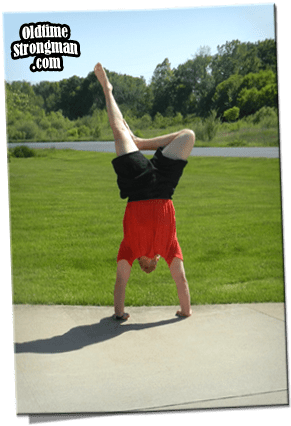
The Basic Hand Stand: All other skills can only be accomplished by mastering this movement. Not bad for a former nose guard with zero previous gymnastic experience!

If you’d have seen me when I started you would never have thought this was even possible.

Yes, it took plenty of practice to be able to do this. Hand balancing is a lot like riding a bike, after a while you just “get it” and you wonder why it ever seemed so difficult in the first place…

Staggered Balancing: Another challenge is to hold a balance with your hands at different heights. One of the most popular methods of doing this is using a common kitchen chair but you can learn to do it just about anywhere.

Yes, that IS a classic MILO globe dumbbell under my right hand (in the interest of full disclosure, it was “blocked” so that it didn’t roll but the ability to hold it otherwise is not too far off.)

The “Figure Four”: Once you get pretty good at the basic hand stand, you can move on to more challenging skills. This intermediate move is called “The Figure Four” since the body looks like a “4” when viewed from the side. You’ll find it discussed in detail on page 41.
Narrow Balancing: Adjusting the width of your base is another way to work on different skills. Look closely and you’ll see that my thumbs are touching, a surprisingly difficult balance. If you want to improve your overhead press, this movement builds tremendous shoulder strength and stability.
So Get Started Already!

You wouldn’t have read this far if you didn’t mean business… It took roughly two decades between the time I first got interested in hand balancing to the time I was actually able to accomplish it but I could have condensed that down to only a few weeks if I knew the right place to begin…When I started, I had the desire and the motivation, but I lacked the know-how. Today, the know-how is now right in front of your face. I can only dream of where I might be if I had Bill Hinbern’s course way back in the day. You have a chance to not just get started, but to get started at the best possible place and know exactly what you should be doing. It is like the difference between taking the long, slow, frustrating road which may or may not get you to where you want to go… or, on the other hand, you can take a straight-line “shortcut” right to the top.

Yes, there will be work involved, there’s no way around that, but there sure won’t be any more work than what is necessary… Hey, if I can learn to do this, anyone can, take the plunge and order your copy of Hand-Balancing for Muscular Development right now and maybe one day you will run off and join the circus!

Hand-Balancing for Muscular Development by Bill Hinbern is a paper and ink printed course and is not available in e-book format.

The course is paperback, consiste of 72 pages, profusely illustrated with dozens of rare pen and ink drawings and has a heavy-stock cover. An Anatomy chart, kilo to pounds conversion table and full list of resources are also included.

The contents and topics covered in this course can be found else where on this page.

Order now!Hand-Balancing for Muscular Development by Bill Hinbern
___________$29.99 plus s/h
All Contents, Including Images and Text, Copyright © 2005-2026 by John Wood and Thunderdome Media Inc., Not to be reproduced without permission, All Rights Reserved
Author: John Wood. All contents, including images and text, copyright © 2005-2021 by John Wood and Thunderdome Media Inc. Not to be reproduced without permission. All rights reserved. We will most likely grant permission but please contact us if you would like to repost. IMPORTANT: Equipment and books, courses etc. pictured in blog posts are generally not available for sale unless specifically noted.