Indian Club Resource Page

Posted on Wednesday, October 2nd, 2019 by John Wood
Indian Club Resource Page

Here’s a page where you’ll find all our Indian Club resources in one spot. Click on thumbnails and links to find more information:

Classic Wooden Indian Clubs

It doesn’t get more “Oldschool” than these clubs — each are turned by hand


Fashioned from oak hardwood, the new clubs have a classic look and a perfectly balanced feel.


The approximate weight of each club is branded on the barrel, along with our very cool logo

Get your clubs right here! Oldtimestrongman.com classic clubs are made of American Oak hardwood and available in 1lb., 2lb., and 3lb. sizes. We also have combo sets available in case you would like to save on shipping and order several sizes at once. More info >>>

Indian Club Training Materials

The Text Book of Club Swinging by Tom Burrows
Simple Indian Club Exercises Poster by Staff Sergeant Alfred Moss
Indian Club Exercises Video by Dr. Ed Thomas (Streaming Access)
Indian Club Training Bulletin No. 1 (PDF)

Indian Club Training Guides Available on Amazon Kindle:

Club Swinging For Physical Exercise And Recreation
Light Apparatus Work With Indian Clubs

Indian Club Training Guides Posted in The Iron League

This is only a small sampling, to date we have over 25 Indian club resources — courses and videos — posted in The Iron League.

https://www.ironleague.com/

Indian Club Blog Posts and Articles

An Epic Pair of Indian Clubs
Studded Indian Clubs
George W. Patterson and His Electric Indian Clubs
Vintage Indian Clubs
Unusual Wooden Indian Clubs
Indian Clubs in China
Indian Clubs for Baseball
James J. Corbett’s Indian Clubs
Site Search >>>

Indian Club Videos on Youtube

All Contents, Including Images and Text, Copyright © 2005-2026 by John Wood and Thunderdome Media Inc., Not to be reproduced without permission, All Rights Reserved
Author: John Wood. All contents, including images and text, copyright © 2005-2021 by John Wood and Thunderdome Media Inc. Not to be reproduced without permission. All rights reserved. We will most likely grant permission but please contact us if you would like to repost. IMPORTANT: Equipment and books, courses etc. pictured in blog posts are generally not available for sale unless specifically noted.

Indian Club Training Bulletin

Posted on Wednesday, October 2nd, 2019 by John Wood
Indian Club
Training Bulletin
NEW! Indian Club Training Bulletin No. 2
– Downloadable PDF –
(19 pages)

1. Introduction by John Wood
2. Suggestions To American College Students (1883)
3. Club Swinging Gave Me 25 Pounds of Muscle (1922)
4. Will’s Physical Culture Tobacco Cards (Part 1)
5. Indian Club Q & A
6. Indian Club Resources

$9.99

Indian Club Training Bulletin No. 1
– Downloadable PDF –
(20 pages)

1. Indian Club Q & A #1 by John Wood
2. 1914 Indian Club Course
3. 1905 Indian Club Course
4. The Wrap Up

$12.99

All Contents, Including Images and Text, Copyright © 2005-2026 by John Wood and Thunderdome Media Inc., Not to be reproduced without permission, All Rights Reserved
Author: John Wood. All contents, including images and text, copyright © 2005-2021 by John Wood and Thunderdome Media Inc. Not to be reproduced without permission. All rights reserved. We will most likely grant permission but please contact us if you would like to repost. IMPORTANT: Equipment and books, courses etc. pictured in blog posts are generally not available for sale unless specifically noted.

The Textbook of Club-Swinging by Tom Burrows

Posted on Friday, January 5th, 2018 by John Wood

While Burrows was obviously pretty good at the clubs, he was definitely no one-trick pony: Burrows in addition to his club-swinging prowess, he won the light-heavyweight wrestling championship of Australia … numerous boxing competitions … swimming events … the mile run … high-jumping … broad jumping … cricket matches … gymnastic events … fencing… He was what was once referred to as an “all-rounder” because of his tremendous success in a variety of sports and activities.

Through it all, Burrows maintained that club-swinging exercises “are the finest preparation for all branches of athletics requiring stamina, agility or speed.“

I would certainly agree. While I am certainly not an expert in the magnitude of Mr. Burrows, I have been swinging the clubs for a long while now. To me, swinging Indian Clubs stands out among physical training techniques because it is not only convenient, but also a lot of fun, so “sticking with it” is not an issue like it is with some other forms of training.

The clubs are convenient, so you can do them pretty much anywhere and it is also very rewarding knowing that you are doing something good for your body when you use them.

But aside from these benefits, the clubs are a tremendous way to build strength and condition your body. Graceful Indian Club movements help keep the joints strong and supple, and they certainly build tremendous stamina and toughness, especially when done for time.

In the early 20th century, Burrows wrote several training courses on the clubs, in the hopes that others would come to understand their benefits.

A while ago, we were lucky enough to come across a copy of one of Tom Burrows’ rare club swinging courses and today, we are proud to make “The Textbook of Club-Swinging” once again available to a modern audience.

In “The Textbook of Club-Swinging” Burrows covers all the information that one would have to know to use the clubs successfully.

These include:

The basic movements, notes on form and technique, combinations, proper grip, hints for instructors (in case you want to teach others or start your own class) and even information on endurance club swinging (which Burrows was famous for.)

Our modern reprint edition is brief and to the point, clocking in at 78 pages, 4″ x 6″, fully illustrated with rare pictures and printed on heavy weight paper for the many times that you will thumb through it for information.

The glossy color cover is an entirely new design… If you are into Indian Clubs as much as we are, you simply must have The Textbook of Club-Swinging in your training library!

Order now!The Textbook of Club-Swinging by Tom Burrows:
_________ $19.99 plus s/h
This Man…

Swung a pair of 3-pound, 6-ounce Indian clubs for 100 consecutive hours… he did not sit down… he did not take a water break… he did not stop for even a second… he kept his clubs moving at an average of 80 repetitions a minute for the entire duration…

His name was Tom Burrows, but after accomplishing this amazing feat, from them on, he was known as “The King of Clubs” …

All Contents, Including Images and Text, Copyright © 2005-2026 by John Wood and Thunderdome Media Inc., Not to be reproduced without permission, All Rights Reserved
Author: John Wood. All contents, including images and text, copyright © 2005-2021 by John Wood and Thunderdome Media Inc. Not to be reproduced without permission. All rights reserved. We will most likely grant permission but please contact us if you would like to repost. IMPORTANT: Equipment and books, courses etc. pictured in blog posts are generally not available for sale unless specifically noted.

Indian Club Exercise Poster

Posted on Monday, October 2nd, 2017 by John Wood
“The Indian Club Workout That
Goes Right on Your Gym Wall”
Staff Sgt. Moss
Your Author: Staff Sgt. Alfred Moss– Yes, he looks like he knows a thing or two about physical training.

One of the traditions of Oldtime strength training that we really like a lot are wall charts and posters. Not only do they look really great while hanging in the gym, they also allow for an easy way to follow along and get in a great workout.

So, in keeping this tradition alive, one of the projects that we have been working on was to take a classic Indian Club training course which was written back in the early 1900s and reprint it. We didn’t just reprint it though, we created an entirely different format… turning it into something that not only looks great, but should also help your club swinging as well, you guessed it: an instructional wall chart.

Written in 1905 by the famous strongman, gymnast and physical culturist Staff Sgt. Alfred Moss, “Simple Indian Club Exercsies” will take you step-by-step through the 12 basic Indian Club movements and includes additional suggestions on performance: technique, style, form and cadence etc.

…All you have to do is follow along for a complete Indian Clubs workout.

This poster is printed on high quality enamel paper but, in order to keep that classic look, we “aged” it digitally so that it looks like something that would be hanging in Sandow’s gym or Sig Klein’s place.


Sig Klein’s Gym is long gone, but if it were still around, you
can bet there would be one of these posters on the wall!

The poster is 23 inches by 35 inches in size, comes folded, and looks great as you can see by the picture of it shown above. Think of it as a complete training course that you can hang on your wall instead of putting on your book shelf.

Ordering Options:

You have two options when ordering the “Simple Indian Club Exercises” workout poster. You may either a) order the poster by itself or b) order any Indian club set and the poster will be included at a reduced price. Please click the button below to be taken to our Indian Club order page:

Order now!
All Contents, Including Images and Text, Copyright © 2005-2026 by John Wood and Thunderdome Media Inc., Not to be reproduced without permission, All Rights Reserved
Author: John Wood. All contents, including images and text, copyright © 2005-2021 by John Wood and Thunderdome Media Inc. Not to be reproduced without permission. All rights reserved. We will most likely grant permission but please contact us if you would like to repost. IMPORTANT: Equipment and books, courses etc. pictured in blog posts are generally not available for sale unless specifically noted.

Indian Club Order Page

Posted on Sunday, September 17th, 2017 by John Wood
Indian Club Order Page

NB: Covid 19 wreaked havoc on wood suppliers and our Indian club manufacturer was a direct casualty of that — consequently we no longer sell Indian Clubs. However, a quick google search may provide options for other suppliers out there (we have no recommendations.) When you do get your clubs, you will need to know what to do with them, and we have many different Indian club courses and Information products available:

Indian Club Training Bulletin

NEW! Indian Club Training Bulletin No. 1
– Downloadable PDF –
(20 pages)

1. Indian Club Q & A #1 by John Wood
2. 1914 Indian Club Course
3. 1905 Indian Club Course
4. The Wrap Up

$12.99

Simple Indian Club Exercises Training Poster

The “Simple Indian Club Exercises” course was originally written in 1905 by noted physical culturist Staff Sergeant Alfred Moss and is now available as a high quality poster. This poster is 23 inches by 35 inches, printed on high quality heavy stock and comes folded.

Simple Indian Club Exercise Training Poster by Staff Sergeant Moss.

________________ $19.99 plus s/h
Learn The Ancient Art of Indian Club Exercises Video by Dr. Ed Thomas – Streaming Access

Learn The Ancient Art of Indian Club Exercises Video by Dr. Ed Thomas has been included with all Indian club orders placed with us since the very beginning. Initially this video was included on a DVD, but the DVDs are no longer available. Fortunately we are still able to provide this instructional material as a streaming video thanks to modern technology. The links, etc, are ALREADY included with Indian club orders, but if you would like to purchase access separately, you can do so here:

Learn The Ancient Art of Indian Club Exercises Video
by Dr. Ed Thomas – Streaming Access

________________ $19.99

Once you complete your order, you will be sent a PDF which contains a link to a password protected area, the password itself, and some other brief instructions.

Simple Indian Club Exercises Poster by Staff Sgt. Moss

Posted on Sunday, December 4th, 2016 by John Wood

“The Indian Club Workout That
Goes Right on Your Gym Wall”

One of the traditions of Oldtime strength training that we really like a lot are
wall charts and posters. Not only do they look really great while hanging in the
gym, they also allow for an easy way to follow along and get in a great workout.

So, in keeping this tradition alive, one of the projects that we have been working on
was to take a classic Indian Club training course
which was written back in the early 1900s and reprint it.
We didn’t just reprint it though, we created an
entirely different format… turning it
into something that not only looks great, but
should also help your club swinging as well, you guessed it: an instructional wall chart.

Staff Sgt. Moss
Your Author: Staff Sgt. Alfred Moss — Yes, he looks like he knows a thing or two about physical training.

Written in 1905 by the famous strongman, gymnast and physical culturist Staff Sgt. Alfred Moss, “Simple Indian Club Exercsies” will take you step-by-step through the 12 basic Indian Club movements and includes additional suggestions on performance: technique, style, form and cadence etc.

…All you have to do is follow along for a complete
Indian Clubs workout.

This poster is printed on high quality enamel
paper but, in order to keep that classic look,
we “aged” it digitally so that it looks like
something that would be hanging in Sandow’s
gym or Sig Klein’s place.

The poster is 23 inches by 35 inches in size, comes folded, and looks
great as you can see by the picture of it shown above.  Think of it as a complete training
course that you can hang on your wall instead of putting on your book shelf.

All Contents, Including Images and Text, Copyright © 2005-2026 by John Wood and Thunderdome Media Inc., Not to be reproduced without permission, All Rights Reserved
Author: John Wood. All contents, including images and text, copyright © 2005-2021 by John Wood and Thunderdome Media Inc. Not to be reproduced without permission. All rights reserved. We will most likely grant permission but please contact us if you would like to repost. IMPORTANT: Equipment and books, courses etc. pictured in blog posts are generally not available for sale unless specifically noted.

Classic Wooden Indian Clubs

Posted on Sunday, November 20th, 2016 by John Wood
‘HOW TO GET THE WORKOUT OF YOUR LIFE… with only 2 pounds of wood‘
Now You Too Can Build Stronger, Healthier Shoulders (and a Whole Lot More) with a 5000-year old Indian Tradition
Every workout, there you are, pushing and pulling heavy weights (which is definitely a good thing), but there’s more to it than strengthening the muscles alone… You must maintain stronger joints as well.

After all, when you lift weights, you can only lift them in straight lines…but your body moves and functions in a circular manner. This is especially true for the ball-and-socket joint of the shoulder. Think of how many different directions you can move your arm and how few of them you can reach with “weights” alone.

There’s no question that the shoulder girdle is by far one of the most movable areas of the body but it is also one of the most fragile. Regardless of how you use your body, it is very important to keep the shoulders strong, loose, and flexible.

But many people never fully develop their natural shoulder girdle mobility and muscular balance. Let me tell you about a simple training technique that will help you to an incredible degree…

The 5000 Year-Old Tradition That Makes You Stronger…
More Flexible… AND Saves Your Shoulders

Several thousand years ago, Indian wrestlers and warriors prepared themselves for battle by swinging wooden “clubs” to condition their bodies and build upper-body strength.

Indian Club SwingingIndian boys are generally introduced to the clubs around 10 years of age and expected to practice daily. Regular bouts of physical training are known to benefit growing bodies. This rare image dates back to the early 1900’s.

This practice spread amongst many different countries throughout the ensuing centuries — club swinging of some form can be found in nearly every middle-eastern and Asian country.

In the 1800’s, British soldiers started practicing “Indian Club” techniques and brought them back to Europe where the clubs became part of the physical culture tradition.

In time, European immigrants brought Indian Club training to American shores. Club swinging was adopted into American school physical education programs and military physical readiness training.

In the early 20th century, many students began their day with a few minutes of club swinging to wake up mind and body.

Utilizing a series of graceful swinging movements, Indian Club training was a simple method for individuals to build stronger, healthier bodies while promoting joint integrity and improving strength and overall vitality.

Sadly, Indian Club training fell out of favor (at least on these shores) some time around the 1920’s but fortunately they did not disappear forever…

A NEW Era: Ancient Training Tools for Modern Results

The benefits of club swinging are endless …and now you can bring this ancient tradition into your own workout with our New Classic Wooden Indian Clubs. We’ve got three different weights for club swingers of all experience levels.

Our new clubs are made right here in America out of oak hardwood and fashioned from classic designs ~ right from the history books! These classic wooden Indian clubs range from one to three pounds in weight and from 16-1/2 inches to 20 inches in length.

You simply need a space big enough to let you swing the clubs without interference and you are in business. Keep in mind that just because the clubs are “relatively” light doesn’t mean that you aren’t going to get one hell of a workout. When used correctly, the clubs can humble even the strongest of athletes.

It doesn’t get more “Oldschool” than these clubs — each are turned by hand


Fashioned from oak hardwood, the new clubs have a classic look and a perfectly balanced feel.


The approximate weight of each club is branded on the barrel, along with our very cool logo

Why You Can Get a Great Workout with 2 Pounds of Wood

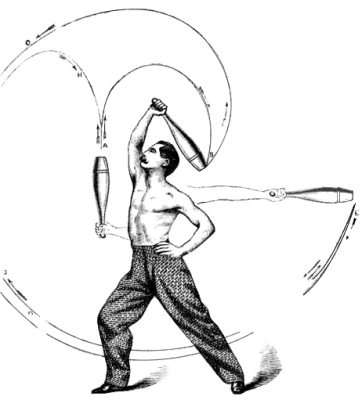
A few of the graceful movements which can be done with a pair of Indian Clubs – they are not just for show, such movements will strength the shoulder girdle to a very high degree.

The biggest question on your mind is undoubtedly whether you really can get a great workout with something as light as a few pounds.

Think about what we are trying to do here (and keep in mind that Indian Club training is not like training with “weights” as you know it) – the clubs allow you to apply resistance in a circular manner, thus improving posture, increasing blood flow, and flexibility to all joints involved. Indian Clubs will help you “open” up your chest, increasing lung capacity and helping you breathe more efficiently.

Remember how I mentioned the shoulder joint earlier? When the ball-and-socket joint of the shoulder is made stronger, aligned, and more mobile, other joints like the wrist and elbow also benefit…and Indian Clubs can exercise the shoulder, wrist and elbow in ways not possible with traditional linear weight training.

The movements are easy to learn and just a few minutes of club swinging makes you feel “solid” and ready for action.

As a strength athlete, shoulder health is of the utmost importance – a few minutes of Indian Club swinging a day will keep your shoulders feeling stronger and more powerful. Indian Clubs have long been popular in the military and even today among modern combat athletes looking for greater shoulder strength and stability.

Of course, Indian Club training will benefit any athlete in any sport.

Indian Club Instructional Materials Also Included!

Just to make sure you learn the correct techniques “right out of the box,” we have also included two different types of instructional materials with each Indian Club package:


Learn the Ancient Art of Indian Club
Exercises with Dr. Ed Thomas
Indian Club Poster
24″ x 36″ Simple Indian Club Exercises Instructional Poster by Staff Sgt. Moss

First up is the how-to video “Learn the Ancient Art of Indian Club Exercises,” which is hosted by Dr. Ed Thomas, a Fulbright scholar, martial artist, and physical education teacher, who has been teaching Indian club and physical education classes in schools across the country for decades.

Dr. Thomas is recognized as THE foremost modern Indian Club expert. This 35-minute instructional video demonstrates all the basic Indian Club swinging movements. This is nopt a physical dvd — once you place your order, you will receive a link to a special page where the video can be viewed online any time day or night.

This video is not a Hollywood production by any means but it will help you figure out what to do with a set of clubs in your hands.

Additionally, back in 1905, the famed strong man, gymnast and physique star Staff Sgt. Alfred Moss put together his own course on Indian Club swinging which outlines all the basic movements one by one.

We have reproduced Staff Sgt. Moss’ course in poster form, making a classy addition to your gym wall. This poster is 24-inches x 36-inches, landscape-oriented, printed on heavyweight, glossy, high-quality poster stock and also digitally “aged” giving it an Oldtime look and feel. This poster looks like it would be right at home in Sig Klein’s Gym or the old Hemmenway Gymnasium at the turn of the century. You can get your own poster with all Indian Club sets ordered from us as a special bonus although they can also be purchased separately on our Indian Club order page.

Indian Clubs: Something your workout has been missing

If you are ready to add Indian Clubs to your routine, look no further than our Classic Wooden Indian Club package. These clubs have a traditional look with a quality finish — you can’t beat Oak hardwood — and great for general use. As indicated above, every set of Indian clubs comes bundled with the Ed Thomas instructional video (streaming) and Staff Sgt. Moss poster as well.

Do NOT underestimate these clubs because of their seemingly light weight. They clubs will give you a great workout, regardless of your strength. When we first received these clubs, I picked up the clubs and gave them a try. I broke a sweat just minutes into the routine. For such a small amount of weight, they sure do make you work.

One additional note about the clubs – they are hand-turned and as with any handmade, natural product they may have small imperfections. Rest assured that these slight differences in the cosmetic appearance of the clubs will not affect their functionality in any way. The weight of each club may also vary slightly but we will always make sure that clubs are matched evenly.

Training with Indian clubs is a great way to improve your overall physical strength, flexibility, and shoulder integrity. They are portable, easy to pick up and use, and will produce results almost immediately. No matter what your age or ability level, these clubs are an excellent workout.

Order now!
Click HERE for Indian Club Ordering Options and Pricing
All Contents, Including Images and Text, Copyright © 2005-2026 by John Wood and Thunderdome Media Inc., Not to be reproduced without permission, All Rights Reserved
Author: John Wood. All contents, including images and text, copyright © 2005-2021 by John Wood and Thunderdome Media Inc. Not to be reproduced without permission. All rights reserved. We will most likely grant permission but please contact us if you would like to repost. IMPORTANT: Equipment and books, courses etc. pictured in blog posts are generally not available for sale unless specifically noted.

Light Indian Club Swinging

Posted on Saturday, October 8th, 2016 by John Wood
Swinging the light clubs is a training methods that has been practiced for thousands of years in other cultures but has only been going on in the U.S. relatively recently. Traditionally this method has been used to build upper body strength and promote shoulder stability — and they work just as well today for the very same reasons. This sequence is from “The Encyclopedia of Indian Physical Culture.”
All Contents, Including Images and Text, Copyright © 2005-2026 by John Wood and Thunderdome Media Inc., Not to be reproduced without permission, All Rights Reserved
Author: John Wood. All contents, including images and text, copyright © 2005-2021 by John Wood and Thunderdome Media Inc. Not to be reproduced without permission. All rights reserved. We will most likely grant permission but please contact us if you would like to repost. IMPORTANT: Equipment and books, courses etc. pictured in blog posts are generally not available for sale unless specifically noted.

CLUB SWINGING: An Ancient Restorative Art for the Modern Martial Artist by Dr. Ed Thomas

Posted on Sunday, August 28th, 2016 by John Wood
CLUB SWINGING:
An Ancient Restorative Art for
the Modern Martial Artist
by Dr. Ed Thomas
Combine today’s understanding of human motion with the wisdom of ancient martial artists,and you get a powerful force that stimulates both mind and body.
Wooden Indian Clubs
A typical set of early 20th-century
wooden Indian clubs

Martial artists past and present have stressed the importance of complementing external power with internal harmony. This balance between restorative and martial arts remains an essential thread running through the fabric of both Eastern and Western martial arts philosophy.

Martial arts are often defined as techniques that allow for appropriate responses to external aggression. Restorative arts bring the body toward its optimal state of harmony and compensate for the stresses of daily life. These two concepts are integrally related, and both have roots in Western as well as Eastern physical culture. The search for and celebration of these common roots and relationships allows the martial artist to better understand the universal principles that unite all fighting systems.

The rediscovery and growing popularity of Indian Clubs may well be the decade’s most interesting development concerning modern restorative and martial arts in American culture. The clubs originated in the East, but they came to America from Europe.

The story of their evolution, disappearance, and rediscovery in American society is intriguing, and the amazing effect of their practical application is relevant to any martial arts system.

Indian Clubs are usually made of wood and resemble either club-like weapons or bowling pins. At one time, they lined the walls of our gymnasia, and countless Americans swung them in marvelous and complicated circular patterns that stimulated the brain and invigorated the body.

A BRIEF HISTORY OF INDIAN CLUBS

The clubs originated centuries ago in India. They were developed by soldiers, police, and others whose caste required strength, agility, balance, physical prowess, and martial arts skill. British officers involved in the annexation of India were surprised to find the natives marvelously expert in swinging clubs in various graceful and fantastic motions, and they noted that besides the great recommendation of simplicity the Indian club practice possesses “the essential property of expanding the chest and exercising every muscle of the body concurrently.” (Spalding, p.77)

The British brought the Indian Clubs to Europe where the Germans and Czechs eventually adopted club swinging into their physical training systems. German immigrants brought Indian clubs to the United States in the mid-1800s, and the clubs were soon introduced into both American school physical education programs and military physical readiness training.

The United States Army Manual of Physical Training (1914) notes:

“The effect of these exercises, when performed with light clubs, is chiefly a neural one, hence they are primary factors in the development of grace and coordination and rhythm. As they tend supple the muscles and articulation of the shoulders and to the upper and fore arms and wrist, they are indicated in cases where there is a tendency toward what is ordinarily known as “muscle bound.” (p.113)
Dio Lewis

Baron Nils Posse

In 1882, Dio Lewis, a pioneer in American physical culture, included Indian clubs in his system of physical education. He wrote of the clubs:

“They cultivate patience and endurance, and operate most happily upon the longitudinal muscles of the back and shoulders, thus tending to correct the habit of stooping.” (p.171)

In 1885, Baron Nils Posse, a Swedish soldier and physical educator, came to America and introduced the Swedish system of medical and military gymnastics. In 1884, his book was published explaining his system, and in it Posse details the difference between lifting dumbbells and swinging clubs.

Lifting dumbbells, he explained, adds weight to the lever (this is the commonly practiced linear lifting). Indian clubs, he continued, increase the momentum of the pendulum (this is the circular nature of club swinging). In other words, Indian clubs can be described as “circular weight training.” Posse also called the Indian club “the oldest known implement for military gymnastics and related it to the broadsword” (p.24).

Indian Clubs gradually disappeared from the American physical education landscape in the first two decades of the 20th century as sports and games replaced the European-based systems of restorative and military exercise.
In 1916, Joseph Cermak joined the futile chorus of Indian club defenders in noting:

“I have heard, and still hear among the professional men and women unfavorable comments about club exercises, but knowing that there is no other kind of hand apparatus that would admit such a great, almost inexhaustible variety of pleasing exercises as the clubs, believing that the clubs should have a prominent place in educational gymnastics, that by collaboration of mind and muscle in these exercises we can develop the highest degree of co-ordination.” (Preface)

In the hands of an expert, the powerful flowing motions of the clubs somewhat resemble the patterns of Filipino Kali. This resemblance is probably because the 5th century Indian Sri Vishaya warriors invaded the Philippines and eventually merged culturally with them. The Visayan people of the central Philippines can be traced to the Sri Vishaya culture. In terms of basic movement patterns, the relationship between Kali and Indian club training is best illustrated by comparing Danny Inosanto’s (1980) explanation of Kali attack angles (Inosanto) with Warman’s illustration of club swinging. Both systems stress flowing circular patterns and the figure-eight motion.

MODERN INDIAN CLUB APPLICATIONS

The shoulder girdle is probably the most movable area of the body, but it is also one of the most fragile. Strength of the shoulders should be complemented by flexibility, and the clubs can contribute to both. When the ball and socket joint of the shoulder works in harmony with the elbow and wrist joints, an almost infinite number of circular patterns is possible.

The basic club patterns are the foundation of all shoulder girdle movements, including those applicable to martial arts. The key to effective use of the clubs is concentration, precision, and practice.

Many if not most Americans do not fully develop their natural shoulder girdle mobility and muscular balance. Ill fitting furniture, poor posture, and our tragically inadequate system of physical education in our nation’s schools are among the many cultural factors that keep us from realizing our highest potential.

Basic club skills offer a safe and very effective means to regain essential shoulder girdle mobility. More advanced club movements include complicated arm and footwork that contribute to overall agility, timing, and dexterity.

The 14th Century French physician Tissot wrote, “movement as such may take the place of many remedies, but all the remedies together can never take the Place of the effect of movement.” Tissot was of course referring to rational and natural human motion. In this regard, a humble respect for the past will create a stronger and more productive present and carry us into a strong and secure future.

Club swinging was rediscovered several years ago at Northern Illinois University near Chicago. Last year it was introduced into the Cho Kwang Do martial arts system based in Atlanta and the U.S. Army off-duty education fitness leadership program at Fort Benning, Georgia.

Club swinging can undoubtedly improve shoulder girdle efficiency, and almost certainly help you become a better martial artist.

But maybe more importantly, it is one of those links to the timeless history that binds us to long forgotten martial artists who mastered themselves in order to better fulfill our common challenge to wisely rule this earth. Perhaps the 17th Century philosopher Pascal said it best: “Those we call the ancients were new in everything.”

All Contents, Including Images and Text, Copyright © 2005-2026 by John Wood and Thunderdome Media Inc., Not to be reproduced without permission, All Rights Reserved
Author: John Wood. All contents, including images and text, copyright © 2005-2021 by John Wood and Thunderdome Media Inc. Not to be reproduced without permission. All rights reserved. We will most likely grant permission but please contact us if you would like to repost. IMPORTANT: Equipment and books, courses etc. pictured in blog posts are generally not available for sale unless specifically noted.

Tom Burrows’ First Club Swinging Record

Posted on Wednesday, December 9th, 2015 by John Wood
On March 20th, 1895, Australian club swinging champion Tom Burrows set out to break his own record of 24 hours on continuous club swinging. In order to do so, he set forth the following conditions:

1. The clubs were to be 2 pounds each and to be 24 inches long.
2. To Swing 50 complete circles each minute.
3. No rest or stop allowed during the 25 hours.
4. No aid of any sort allowed.
5. To swing no fewer than 70,000 complete circles for the record.
6. There would be two judges present at all times to watch the swinging.

Burrows commenced swinging his clubs at 9:18 pm on Wednesday evening. At 10:18 pm the next day, he officially met his mark of 25 continuous hours of club swinging but he didn’t stop there. At 11:33 pm, he finally put down his clubs having established the mark of 26 hours and 15 minutes of continuous swinging. The above photograph is from that evening (I’m quite curious about the axes.)